
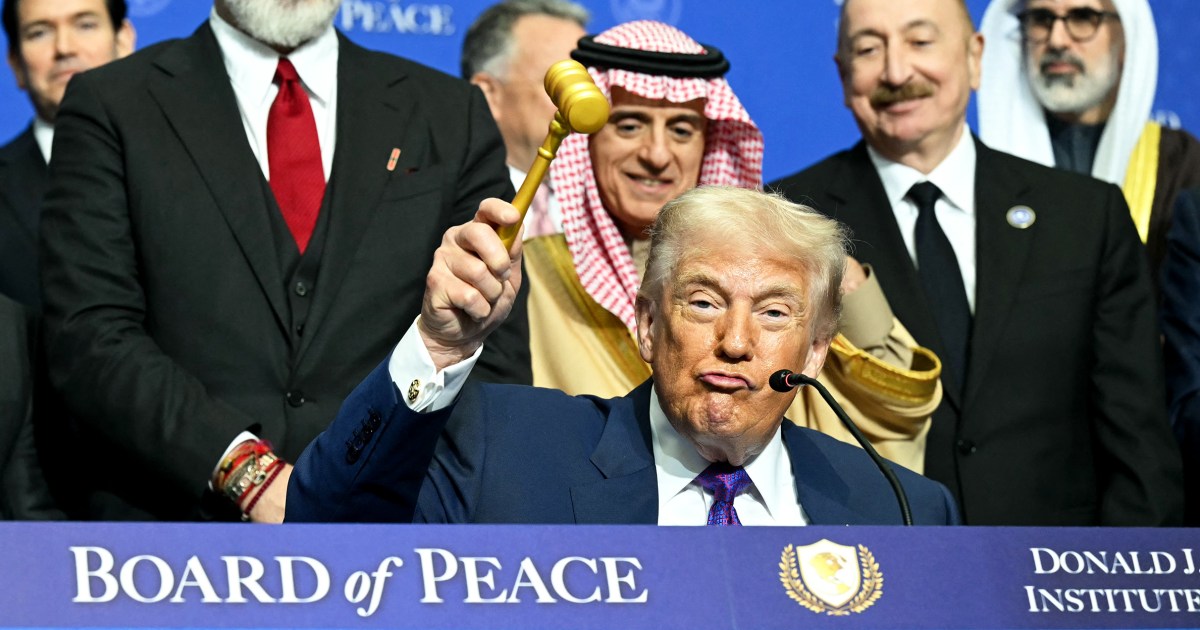
Image courtesy of NBC News. From ‘What Trump’s first Board of Peace summit signals about Gaza’s future’ (February 20, 2026). Credit: Chantal Da Silva. Source: https://www.nbcnews.com/world/gaza/board-of-peace-gaza-trump-reconstruction-israel-rcna259860. © Original owner. Used under fair use.
Billions of dollars earmarked for Gaza reconstruction signal hope, but doubts remain
=================================================================================
On a crisp autumn day in October 2023, a meeting took place at the White House that held the promise of bringing peace and stability to one of the world’s most troubled regions. The location was an opulent room filled with exquisite tapestries, grand fireplaces, and gilded mirrors – a stark contrast to the desolate and impoverished landscape just 3,000 miles away.
The attendees were an eclectic mix of world leaders, business tycoons, and diplomats, all gathered to discuss a common goal: revitalizing the Gaza Strip, a region ravaged by decades of conflict and destruction. The enclave, a mere 25 miles long and less than 10 miles wide, has been a hotbed of violence for years, with Israel and its Palestinian adversaries locked in a seemingly endless cycle of violence and retribution.
For many who attended the summit, the prospect of bringing peace to Gaza was tantalizing. Billions of dollars were pledged for reconstruction efforts, and a promise of an international stabilization force to help secure the enclave’s future. But even as hope flickered, doubts lingered in the minds of many – doubts about whether this latest effort would succeed where so many others had failed.
The summit, which lasted more than four hours, was led by President Donald Trump, who had made Gaza a personal cause since taking office. Trump’s son-in-law and White House adviser Jared Kushner played a pivotal role in the negotiations, leveraging his family’s extensive business ties to bring in private investment and support for the reconstruction effort.
Trump, ever the showman, began the summit with a flourish, declaring that “we will straighten it out” and make Gaza peaceful. He then proceeded to outline an ambitious plan that would see billions of dollars poured into the enclave over the next several years, with funding promised from countries including Kazakhstan, Azerbaijan, the United Arab Emirates, Morocco, Bahrain, Qatar, Saudi Arabia, Uzbekistan, and Kuwait.
Trump separately announced that the U.S. was committing an additional $10 billion to the Board of Peace initiative, though it remained unclear where exactly this money would be allocated. He also reiterated his call for full disarmament by Hamas, including the handover of all weapons and the dismantling of underground tunnel networks and production facilities.
The prospect of a lasting peace in Gaza seemed tantalizingly close, but many attendees remained skeptical. Norman, an associate fellow at Chatham House’s Middle East and North Africa Program, had been critical of previous attempts to bring stability to the region and predicted that reconstruction efforts would face significant challenges.
“I don’t think we should be too optimistic about their ability to change things on the ground very soon,” Norman said ahead of the summit. “It’s difficult to rebuild a region that has been so severely destroyed, especially when there are ongoing tensions and conflicts.”
The fate of Gaza hung in the balance, with many attendees aware that the success of the reconstruction effort would hinge on addressing longstanding grievances held by Palestinians. A central focus of the reconstruction plans was rebuilding Rafah, a city in the southern Gaza Strip that had been devastated by Israel’s military offensive and served as a crucial lifeline for the region.
Yakir Gabay, an Israeli businessman and son of senior officials who had been tasked with leading the reconstruction bid, outlined plans to develop Gaza’s coastline into a “new Mediterranean Riviera” with 200 hotels and potential islands. He spoke passionately about turning the enclave into the “Riviera of the Middle East,” echoing Trump’s past calls for the region to be transformed into a hub of tourism and commerce.
But even as the attendees pledged their support for the reconstruction effort, doubts lingered about its success. Israel had made clear that it wanted full disarmament by Hamas, including the handover of all weapons and the dismantling of underground tunnel networks and production facilities. This demand was met with resistance from many Palestinian leaders, who argued that such measures were not the solution to the region’s problems.
The lack of Palestinian representation on the Board of Peace also raised concerns about the initiative’s ability to succeed. While Hamas had been excluded from the board, representatives from other Palestinian factions were present at the summit. But these leaders faced criticism from many attendees for not doing enough to bring stability to Gaza.
A number of countries had opted not to join the initiative due to the lack of Palestinian representation on most of the bodies created alongside the Board of Peace. Indonesia, which had committed to leading the international force tasked with securing the enclave, had faced criticism from some attendees for its handling of the situation in the region.
Indeed, many attendees remained skeptical about the ability of the reconstruction effort to succeed without addressing the underlying issues that had contributed to Gaza’s ongoing instability.
“We need to address the root causes of this conflict,” said Dr. Ali Shaath, chief commissioner of the National Committee for the Administration of Gaza. “If we don’t do that, we will never be able to achieve lasting peace.”
Shaath, who had been appointed to oversee day-to-day administration in the enclave, acknowledged that the conditions on the ground were “extremely difficult” and that any reconstruction effort would face significant challenges.
“Law and order remain fragile,” Shaath said. “This is not normal operating environment.”
Despite these challenges, many attendees remained hopeful that the reconstruction effort could succeed where previous attempts had failed. For them, Gaza represented more than just a region torn apart by conflict – it was a chance to create a better future for millions of people who had been displaced and suffering for years.
“This is an opportunity to change the narrative,” said one attendee, a business executive from the United Arab Emirates. “We have a chance to create a new chapter in Gaza’s history.”
But even as attendees embraced this vision of hope, they knew that the road ahead would be long and fraught with challenges. For them, Gaza represented not just an opportunity for progress – it was also a test of their ability to overcome longstanding divisions and tensions in the region.
As the summit drew to a close, attendees left with a renewed sense of purpose and determination. While many questions remained unanswered, they knew that the future of Gaza – and ultimately, the fate of millions of people living in the region – rested on their shoulders.
The meeting concluded with a pledge from Trump to commit $10 billion to the Board of Peace initiative, with funding promised from countries including Kazakhstan, Azerbaijan, the United Arab Emirates, Morocco, Bahrain, Qatar, Saudi Arabia, Uzbekistan, and Kuwait. The commitment was met with mixed reactions, with some attendees expressing optimism while others questioned the long-term viability of such an effort.
For many who attended the summit, Gaza represented a chance to create a better future for millions of people living in the region. But even as they embraced this vision of hope, they knew that the road ahead would be long and fraught with challenges. Ultimately, whether Gaza can be transformed into a hub of prosperity and peace remains an open question – one that will require the collective efforts and determination of leaders and citizens alike.
For everyday Americans, the prospect of Gaza’s reconstruction raises questions about the role of international intervention in resolving complex conflicts. While the reconstruction effort is a noble goal, it also raises concerns about the long-term viability of such an endeavor and the potential consequences for U.S. foreign policy.
What do you think? Is Gaza’s reconstruction a chance to create a new chapter in the region’s history, or is it destined to fail like previous efforts? And what role should the United States play in this process? Share your thoughts below.
Conclusion
===========
The reconstruction of Gaza remains a complex and challenging endeavor, one that requires the collective efforts of leaders and citizens alike. As the summit drew to a close, attendees left with a renewed sense of purpose and determination, but also questions about the long-term viability of such an effort. The future of Gaza – and ultimately, the fate of millions of people living in the region – remains uncertain, and it will be interesting to see how events unfold in the coming years.
For everyday Americans, the prospect of Gaza’s reconstruction raises questions about the role of international intervention in resolving complex conflicts. While the reconstruction effort is a noble goal, it also raises concerns about the long-term viability of such an endeavor and the potential consequences for U.S. foreign policy. As with any global issue, it will be important to carefully consider the implications and risks associated with any decision to become involved in Gaza’s reconstruction – both at home and abroad.
As always, we welcome your thoughts on this topic. What do you think? Is Gaza’s reconstruction a chance to create a new chapter in the region’s history, or is it destined to fail like previous efforts? And what role should the United States play in this process? Share your thoughts below.
Source:
NBC News