
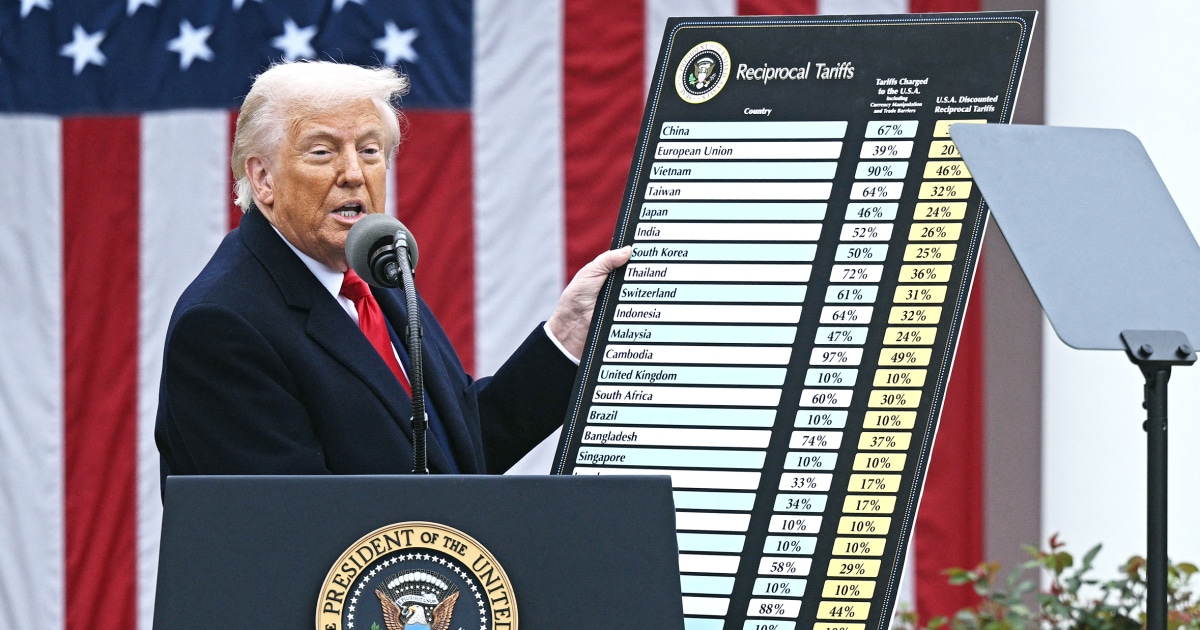
Image courtesy of NBC News. From ‘Supreme Court strikes down most of Trump’s tariffs’ (February 20, 2026). Credit: Lawrence Hurley. Source: https://www.nbcnews.com/politics/supreme-court/supreme-court-strikes-trumps-tariffs-major-blow-president-rcna244827. © Original owner. Used under fair use.
WASHINGTON — The Supreme Court struck a major blow to President Donald Trump’s tariff policies Friday, ruling that he had exceeded his authority by imposing sweeping tariffs on products entering the United States from across the world. The decision invalidates many but not all of Trump’s tariffs, and it is a rare setback for the administration at the Supreme Court, with a 6-3 conservative majority.
The Supreme Court ruling invalidates most of President Donald Trump’s tariffs on products entering the United States from across the world. The court held that Trump’s aggressive approach to tariffs using a law reserved for a national emergency was not permitted under the International Emergency Economic Powers Act (IEEPA). Speaking at the White House, Trump harshly criticized the ruling and dissenting justices as “very unpatriotic and disloyal to the Constitution.”
The court ruled that Trump’s tariffs were not authorized under a law reserved for a national emergency, which is a rare setback for the administration at the Supreme Court. The ruling invalidates many but not all of Trump’s tariffs. The justices ruled that Trump’s aggressive approach to tariffs was not permitted under the IEEPA.
Business owners who had to pay the tariffs and challenged them in court expressed relief at the ruling. Victor Schwartz, a New York-based wine and spirits importer, said the duties were arbitrary, unpredictable, and bad business. He thanked the courts for recognizing these duties as unconstitutional government overreach. The decision does not affect all of Trump’s tariffs, leaving in place ones he imposed on steel and aluminum using different laws. However, it upends his tariffs in two categories: country-by-country or “reciprocal” tariffs and a 25% tariff Trump imposed on some goods from Canada, China, and Mexico for what the administration said was their failure to curb the flow of fentanyl.
The court did not directly address the issue of fentanyl but said that Kavanaugh’s dissent raised valid concerns about the impact on the U.S. Treasury. The ruling is likely to greatly restrict Presidential tariff authority going forward outside of the IEEPA context. We Pay the Tariffs, a group of small businesses that oppose Trump’s tariffs, immediately called for a “full, fast and automatic” refund process.
The Constitution assigns the power to set tariffs to Congress. Still, Trump used IEEPA, which does not specifically mention tariffs but allows the president to regulate imports and exports during an emergency due to an unusual and extraordinary threat. Before Trump, no president had ever used that law to tariff imports. Lower courts ruled against the administration in two related cases, with both sides asking the Supreme Court to issue a definitive ruling.
The decision is a rare setback for the administration at the Supreme Court, which has a 6-3 conservative majority since Trump began his second term in January 2025. The court did not directly address the fentanyl issue but said that Kavanaugh’s dissent raised valid concerns about the impact on the U.S. Treasury.
The decision is a victory for small businesses and importers who had to pay the tariffs, which were arbitrary, unpredictable, and bad business. The court ruled that IEEPA does not authorize the president to impose tariffs, which was a rare setback for the administration at the Supreme Court.
For everyday Americans, this ruling means that many products entering the United States from across the world will become cheaper. This decision also upends some of President Trump’s trade policies, which had significant impacts on businesses and consumers alike. The ruling is a victory for small businesses and importers who had to pay the tariffs, which were arbitrary, unpredictable, and bad business.
In conclusion, the Supreme Court’s ruling is a rare setback for President Trump at the Supreme Court, with a 6-3 conservative majority. The decision invalidates many but not all of Trump’s tariffs and upends his trade policies in two categories. The decision is a victory for small businesses and importers who had to pay the tariffs, which were arbitrary, unpredictable, and bad business.
Source:
NBC News