
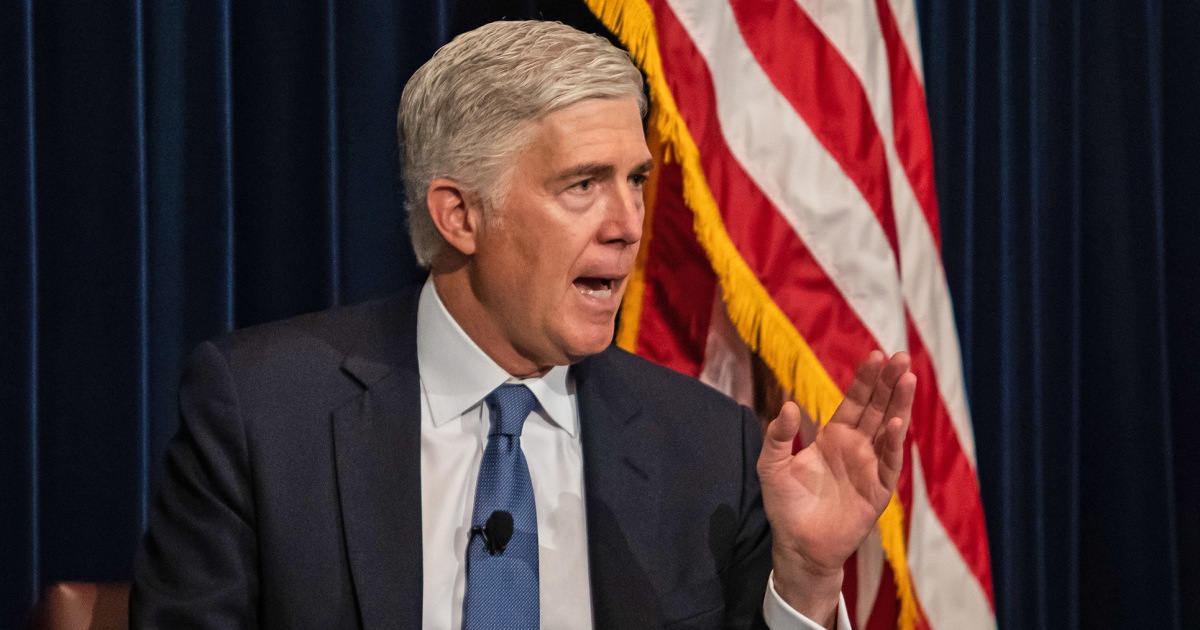
Image courtesy of NBC News. From ‘In tariff case, Supreme Court justices bicker over treating Trump and Biden differently’ (February 21, 2026). Credit: Lawrence Hurley. Source: https://www.nbcnews.com/politics/supreme-court/tariffs-case-supreme-court-justices-bicker-biden-trump-treatment-rcna259922. © Original owner. Used under fair use.
In Tariff Case, Supreme Court Justices Bicker Over Treating Trump and Biden Differently
===============================================================================
Conservative Justice Neil Gorsuch pulled no punches in taking aim at his colleagues on the Supreme Court for a lack of consistency in approaching broad assertions of presidential power made by Joe Biden and Donald Trump. His colleagues were effectively applying the same Supreme Court precedent differently under Trump than they did under Biden, he argued, writing: “It is an interesting turn of events.”
But in ruling against Trump on tariffs Friday, the conservative majority splintered. Gorsuch, Justice Amy Coney Barrett and Chief Justice John Roberts were in the majority, finding in part that Trump’s tariffs needed to go through Congress. Three others, Justices Clarence Thomas, Brett Kavanaugh and Samuel Alito, dissented.
“It shows you how much internal dissension there is on the Supreme Court right now,” said Robin Effron, a professor at Fordham University School of Law. Roberts’ 21-page majority opinion reads as if he hoped it would attract nine votes, she added, but instead it was a “huge internal fail.”
Even some of the justices who agreed with the outcome did not sign on to the part of Roberts’ opinion that sought to adopt the major questions doctrine in curbing Trump’s tariffs, raising questions about how it will be applied in future cases. While the court’s three liberals, who backed Biden and criticized the major questions doctrine in past rulings, were in the majority against Trump, they again did not embrace the theory.
Gorsuch, who has wholeheartedly supported the major questions doctrine, pointed to his colleagues’ waffling on the issue in his opinion. “Past critics of the major questions doctrine do not object to its application in this case,” he said, in a reference to the liberal justices. “Still others who have joined major questions decisions in the past dissent from today’s application of the doctrine,” he added, referring to the dissenting conservatives.
Thomas, Kavanaugh, Barrett and liberal Justice Elena Kagan all felt the need to respond to Gorsuch in their own opinions (which might be one reason why the court took months to decide the case). “Given how strong his apparent desire for converts, I almost regret to inform him that I am not one,” Kagan quipped in a footnote directed at Gorsuch.
Jonathan Adler, a professor at William & Mary Law School, said Gorsuch’s critique of Kagan had merit, saying it is “hard to square” her opinion on Friday with her previous votes. But Ilya Somin, a professor at George Mason University’s law school who joined the legal challenge to the tariffs, said the dissenting conservatives were just as guilty of contradicting themselves. In his opinion, Kavanaugh argued in part that the major questions doctrine does not apply to tariffs because of foreign affairs considerations.
For everyday Americans, this battle over treatment of Trump and Biden could mean a difference in how powerful they feel their president is. If the court continues to rule against Trump in cases like this one, he may have less ability to make unilateral decisions without Congressional oversight. On the other hand, if the court adopts a more flexible approach, it could open up a Pandora’s box of possibilities where presidents can bypass Congress on major issues.
For now, it is unclear how the Supreme Court will handle future cases involving Trump or Biden. But one thing is clear: the internal dissension at the highest level of American judiciary is far from over. In a time when political polarization has reached new heights, this fight over treatment of two different presidents is just one example of how deeply divided our nation remains.
What does
Source:
NBC News